Pressure Washer Power Calculator
Ever watched a pro clean a driveway in half the time it would take you, with half the effort? You’re probably wondering if they have some secret weapon. The truth is simpler: they just use different tools. While you might be eyeing that bright yellow machine at the hardware store, professionals rely on heavy-duty equipment built for endurance, power, and efficiency.
If you are thinking about starting a side hustle or just want to understand why your residential unit struggles with stubborn grime, knowing what separates commercial gear from consumer-grade toys is crucial. It’s not just about buying the most expensive thing on the shelf; it’s about understanding specs like PSI, GPM, and pump materials.
Quick Takeaways
- Pros use gas-powered units: For mobility and raw power, gas engines dominate the professional scene, unlike corded electric models used by homeowners.
- GPM matters more than PSI: Professionals prioritize Gallons Per Minute (flow rate) over PSI (pressure) because water volume moves dirt faster.
- Triplex pumps are standard: Unlike axial cam pumps in cheap units, pros use triplex plunger pumps made of iron or ceramic for longevity.
- Surface cleaners are essential: Pros rarely use wand tips alone; they use wide surface cleaners to cover large areas quickly and evenly.
- Duty cycle is key: Commercial machines can run for hours without overheating, whereas residential units often need frequent breaks.
The Core Difference: Commercial vs. Residential Specs
When you walk into a big-box store, you see machines labeled "Residential" or "Consumer Grade." These are designed for occasional use-maybe cleaning a patio once or twice a month. They are lightweight, affordable, and usually electric. But turn on one for an hour straight, and the plastic fittings might melt, or the motor might burn out. That’s where the professional grade comes in.
Commercial Pressure Washers are heavy-duty cleaning systems designed for continuous daily use, featuring industrial-grade components and higher flow rates. Unlike their residential counterparts, these machines are built to withstand the rigors of job sites, extreme temperatures, and long operating hours.
The biggest giveaway isn’t always the brand name. It’s the construction. A professional unit will feel heavy. Not just because of the frame, but because the internal components are metal, not plastic. The unloader valve, which regulates pressure when you release the trigger, is a critical component. In cheap units, this is plastic and prone to failure. In pro units, it’s brass or stainless steel.
Consider the duty cycle. This refers to how long the machine can run before it needs a rest. A residential electric washer might have a 30% duty cycle, meaning it should run for 18 minutes every hour. A commercial gas unit often has a 100% duty cycle, allowing it to run continuously all day. If you are trying to clean a two-story house, a 30-minute break in the middle of the roof line is going to kill your momentum.
Gas vs. Electric: Why Pros Choose Gas
You might wonder why almost every pro I’ve seen uses a gas engine. Isn’t electric quieter and easier to start? Sure, but there are three main reasons gas dominates the professional world: power, portability, and independence.
First, let’s talk power. To get high pressure and high flow simultaneously, you need significant horsepower. Electric motors available for portable units top out around 3-4 HP effectively. Gas engines can easily deliver 5-9 HP. This extra power allows the pump to push more water at higher pressures without straining.
Second, portability. When you are working on a commercial property, you aren’t always near an outlet. Running a 50-foot extension cord across a parking lot is a trip hazard and a nuisance. Gas units are self-contained. You fill them with fuel, add oil, and go. Many pros mount their washers on heavy-duty carts with pneumatic tires, making them easy to maneuver over curbs and rough terrain.
Third, voltage stability. Large electric pressure washers require 240-volt outlets, similar to what you use for a dryer or oven. Most homes don’t have these readily available outside. Even if they do, running a heavy load down a long extension cord causes voltage drop, which can damage the motor. Gas eliminates this electrical headache entirely.
| Feature | Gas-Powered (Professional) | Electric (Residential/Light Pro) |
|---|---|---|
| Mobility | High (No cords required) | Low (Limited by cord length/outlets) |
| Power Output | High (5-9+ HP) | Medium (2-4 HP equivalent) |
| Noise Level | Loud (Requires hearing protection) | Quiet |
| Maintenance | Higher (Oil changes, spark plugs, air filters) | Low (Check connections, no fluids) |
| Cost | Higher upfront cost | Lower upfront cost |
| Duty Cycle | 100% (Continuous run) | 30-50% (Intermittent use) |
Understanding PSI and GPM: The Real Metrics
Here is where most beginners get confused. Marketing teams love to advertise PSI (Pounds per Square Inch). They slap huge numbers like "4000 PSI" on the box. But here is the secret: professionals care more about GPM (Gallons Per Minute).
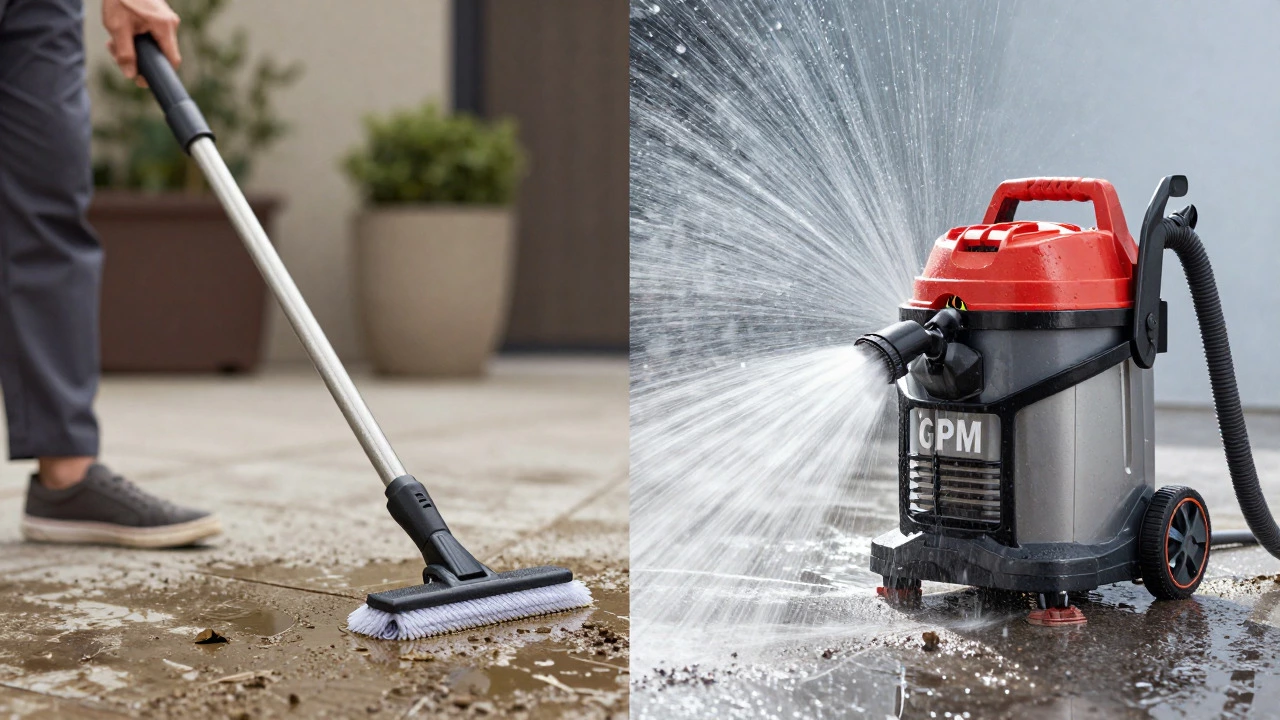
Think of it this way. PSI is how hard you hit the dirt. GPM is how much dirt you move away. If you have high pressure but low flow, you are blasting the same spot repeatedly. It’s like trying to wash a car with a toothbrush-it takes forever. If you have high flow, even at moderate pressure, the volume of water strips the dirt away efficiently.
A typical residential washer might offer 3000 PSI but only 1.5 GPM. A professional unit might offer 2500 PSI but 3.0 GPM or higher. The pro unit will clean twice as fast because it is using twice the water. This is known as Cleaning Units (CU), calculated by multiplying PSI x GPM. A machine with 3000 CU is significantly more effective than one with 2000 CU, regardless of the pressure rating.
For soft washing roofs or siding, pros actually lower the PSI drastically (to under 500 PSI) but keep the GPM high. This ensures the chemical solution penetrates the surface and rinses off without damaging shingles or wood fibers. High pressure alone doesn’t clean biological growth; chemistry does. Flow rate ensures that chemistry works properly.
The Heart of the Machine: Pump Types
If the engine is the muscle, the pump is the heart. And not all hearts are created equal. There are two main types of pumps you will encounter: axial cam and triplex plunger.
Cheap, entry-level washers use axial cam pumps. These are simple, compact, and inexpensive. However, they are generally made with aluminum or plastic pistons and seals. They struggle with heat dissipation and are sensitive to cavitation (air bubbles entering the pump). If you run an axial cam pump dry for even a few seconds, it can destroy the seals. This is why they are rated for intermittent use.
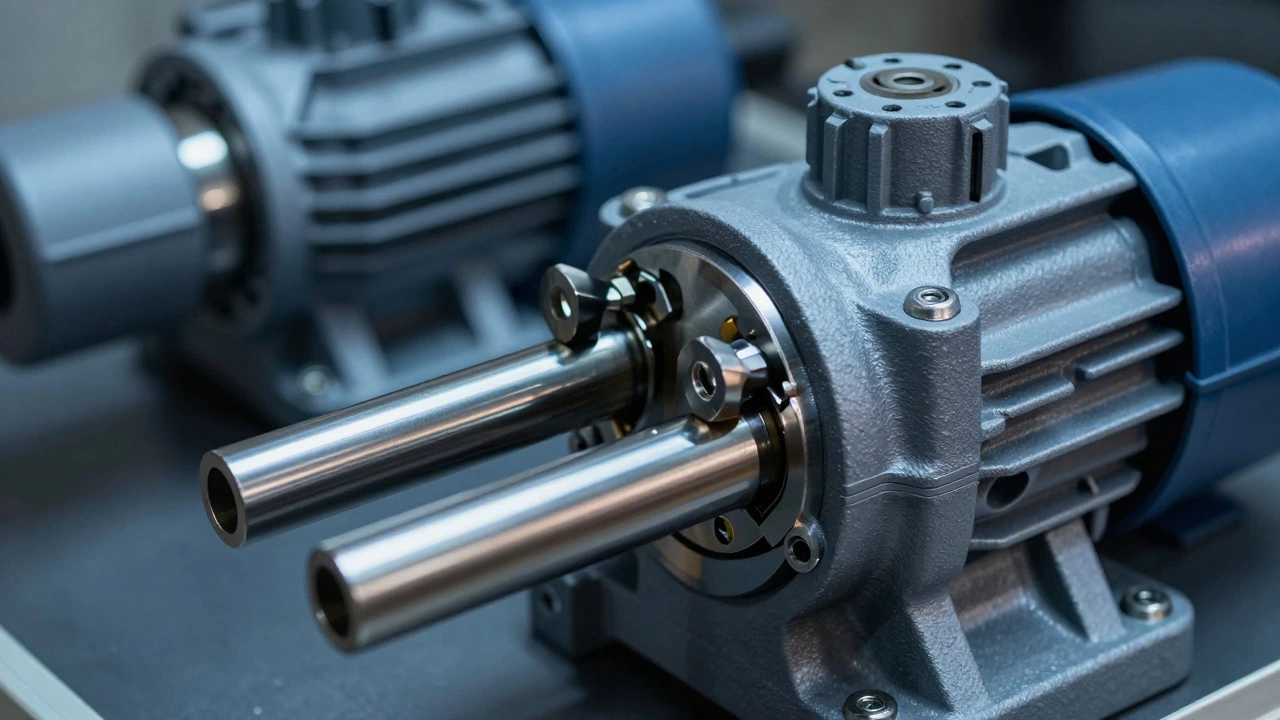
Professionals use Triplex Plunger Pumps, which are industrial-grade pumps with three plungers that operate sequentially to provide smooth, high-pressure water flow with minimal vibration. These pumps are larger, heavier, and more expensive. They feature ceramic or iron plungers and hardened steel valves. Because the three plungers fire in sequence, the output is smoother, reducing wear on hoses and fittings.
More importantly, triplex pumps handle heat better. They are designed to run hot for extended periods. Brands like Honda, Kohler, and Briggs & Stratton make the engines, but companies like LSI, Titan, and Sundstrand make the pumps that pros trust. When buying a pro unit, check the pump warranty. A true commercial pump will come with a 3-year or longer warranty, while residential pumps often have 1-year warranties.
Essential Attachments: Beyond the Wand
You won’t catch a pro holding a spray wand for more than a minute. Wands are for detail work. For broad surfaces like driveways, sidewalks, and patios, professionals use surface cleaners.
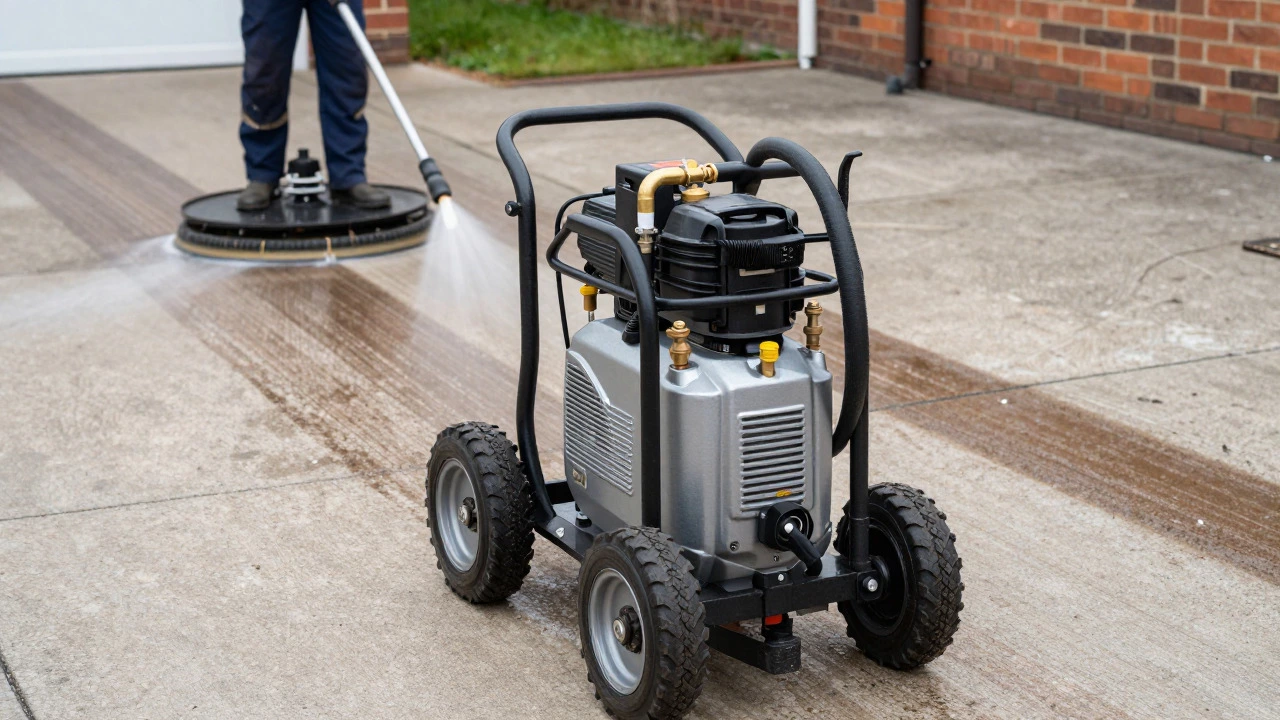
A Surface Cleaner is a rotating attachment with multiple nozzles that sits close to the ground, providing even cleaning stripes and preventing etching or uneven results. Imagine a lawnmower head attached to your pressure washer hose. As it rotates, it sprays water in a circular pattern. This keeps the nozzles at a consistent distance from the surface, eliminating the streaks you get when your hand gets tired and you lift the wand too high.
Surface cleaners also protect the substrate. By keeping the pressure distributed over a wider area, you reduce the risk of gouging concrete or stripping paint. Pros typically use 20-inch or 26-inch surface cleaners for residential driveways. For large commercial parking lots, they might use tow-behind surface cleaners that attach to a truck.
Another tool pros rely on is the turbo nozzle or rotary jetter. Unlike a standard fan tip, a turbo nozzle spins rapidly, creating a concentrated beam of water that cuts through grease and oil stains on asphalt. It’s like having a tiny, high-pressure drill bit made of water. For delicate tasks, like cleaning windows or gutters, pros use extension wands that allow them to stay on the ground rather than climbing ladders.
Top Brands Trusted by Professionals
While brands matter less than specs, certain manufacturers have earned a reputation for reliability in the field. Here are the names you will see on job sites:
- Husqvarna: Known for their ergonomic design and reliable gas engines. Their K-series is popular among residential pros.
- Kärcher: The German giant offers both consumer and industrial lines. Their HD series is robust and widely used in Europe and increasingly in the US.
- Simpson: Offers a range of mid-to-high-end commercial units. Good balance of price and performance for startups.
- Toro: Famous for their PowerShot series. These are built like tanks and often come with excellent dealer support.
- Genesis: A favorite for mobile detailing and light commercial work. Their cart-mounted systems are highly regarded for durability.
It’s worth noting that many pros build their own rigs. They might buy a bare engine from Honda, a pump from LSI, and assemble it on a custom cart. This allows for maximum customization but requires mechanical skill. For most people starting out, buying a pre-assembled commercial unit from a reputable brand is the smarter choice.
Maintenance: Keeping Your Investment Alive
Owning a professional pressure washer means accepting responsibility for its maintenance. Unlike a disposable residential unit, a pro machine is an investment that can last 10 years or more if cared for. Neglect it, and it will die in two.
The most critical task is winterization. Water expands when it freezes. If you leave water in the pump during winter, it will crack the cast iron block. Pros use pump saver fluid-a non-toxic antifreeze specifically designed for pressure washers. They flush the system after every use, especially if they’ve been using detergents or chemicals that can corrode internal parts.
Regular checks include:
- Engine Oil: Change according to the manufacturer’s schedule (usually every 100 hours). Use the correct viscosity oil.
- Air Filter: Clean or replace regularly. A clogged filter reduces engine power and increases fuel consumption.
- Fuel System: Use fuel stabilizer if the unit sits for more than a month. Stale gas gums up carburetors.
- Hoses and Fittings: Inspect for cracks or leaks. High-pressure water can cut skin like a knife; a burst hose is dangerous.
- Pump Lubrication: Some pumps require periodic greasing of the shaft seal. Check your manual.
Finally, always start the machine with the trigger gun pulled. This allows water to flow freely as the pump builds pressure, reducing strain on the unloader valve. Never let the pump run dry for more than a few seconds. Cavitation is the enemy of pressure washers.
Is Professional Equipment Worth It for Homeowners?
Probably not. Unless you plan to start a business, a commercial pressure washer is overkill. They are loud, heavy, require regular maintenance, and cost significantly more. For most homeowners, a mid-range residential electric or small gas unit is sufficient. Save your money and hire a pro for the big jobs. Let them use their heavy machinery while you enjoy the clean driveway.
Can I use a residential pressure washer for a business?
Technically yes, but it’s risky. Residential units have limited duty cycles and weaker pumps. If you’re doing one-off jobs, it might work. But for regular income, you’ll likely burn out the machine within a year, costing you more in replacements than saving on the initial purchase. Invest in a commercial-grade unit with a triplex pump for longevity.
Do professionals use hot water pressure washers?
Yes, especially for grease, oil, and food service cleaning. Hot water melts fats and oils that cold water cannot remove. However, hot water units are more complex, expensive, and require more maintenance due to the heating element and boiler system. For general exterior cleaning (driveways, siding), cold water with detergent is usually sufficient.
What is the best PSI for cleaning a driveway?
For concrete driveways, 3000-4000 PSI is common, but remember that GPM is equally important. A 2500 PSI machine with 3.0 GPM will clean faster than a 4000 PSI machine with 1.5 GPM. Always use a surface cleaner attachment to ensure even cleaning and prevent etching the concrete.
How much does a professional pressure washer cost?
Entry-level commercial units start around $1,500-$2,500. Mid-range models with better engines and pumps range from $2,500-$4,000. High-end industrial units can exceed $5,000-$10,000. Remember to factor in the cost of accessories like surface cleaners, hoses, and detergent tanks.
Why do pros use surface cleaners instead of wands?
Surface cleaners provide consistent pressure distribution and coverage speed. Wands create uneven stripes and require constant arm movement, leading to fatigue. Surface cleaners keep the nozzles at a fixed height, preventing damage to the surface and ensuring a uniform finish. They are significantly faster for large flat areas.